 ecoStory -
volume one, number 2, 30 July 1998
ecoStory -
volume one, number 2, 30 July 1998
|
|
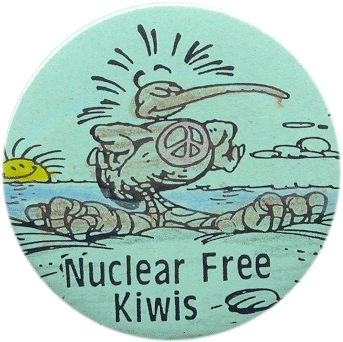
A kiwi is "a flightless bird that forages in the dark". Unfortunately, my ladybird English children's dictionary does not have a listing for 'kiwi' nor 'Kiwi'. Small wonder that overseas customers believe Kiwis are kiwifruit from just any country. But the New Zealand kiwifruit marketing people cleverly created a brand name that sounds like an Italian scooter. This vehicle helps to clarify that real kiwifruit come from New Zealand, also the home of 35000 North Island brown kiwi; 22000 great spotted kiwi; 225 Haast Tokoeka kiwi; 27000 Southern Tokoeka kiwi, of which 20000 live in relative safety on Steward Island; 3781500 big-foot Kiwis; 1100 little spotted kiwi, surviving on Kapiti Island; and 140 Okarito brown kiwi. That makes a total of 3866966, including the kiwi that recently hatched under caring Kiwi supervision in Wellington's Zoo. Earlier this century the 'kee wee' found wide-spread international fame because of a certain brand of boot polish. Ironically, in 1942 a war correspondent found it noteworthy that old tins were littering the landscape in the Sahara near Tobruk. Kiwis are usually very proud of their green and clean home country. 'Home is where the heart is', and that's normally the place where one grew up. Touaregs love the Sahara. Kiwis love New Zealand. They would go to war to defend their homes, green pastures, native bush, mountains and blue seas in the South Pacific. A remarkable feat of defence was the united Kiwi stance to stay nuclear-free in the nineteeneighties. Unfortunately, on the rugby field the All Blacks Kiwi team underperformed recently. About 70 million years ago the Tasman Sea separated New Zealand from Australia. In the absence of predating non-flying animals, the kiwi saw no further use in the energy-intensive habit of flying. Why waste effort to find the extra fuel needed for flying if one can have an easy life on the ground? Sensible 'energy-efficient' animals! Kiwi nightlife attracted the kiwi since darkness gave protection against preying eagles. Food can be detected using the nostrils at the tip of the long bill. So kiwi can find their diet of insects and berries even in the dark and under several centimeters of soil. A kiwi has good eyesight, and remarkable strong and quick moving legs. The adult brown kiwi has a size of 70 centimetres (27.5 inch) and defends its turf aggressively against intruders. Yet the kiwi are endangered, at the end of a sheltered existence of many millions of years. Their lifestyle and body equipment make them ill-prepared for modern life. Introduced species, such as stoats, ferrets, wild cats, rats, possums, poisoned bait, possum traps, and loss of habitat are reducing their numbers. A couple of years ago one loose dog killed 500 kiwi over a period of six weeks. Fortunately Kiwis are aware of the threats to this symbol of their national identity, and efforts are made to prevent kiwi extinction. Safe, predator-free areas are maintained and natural habitats protected. On the battlefield of the global environment, however, Kiwis still seem to believe in a sheltered existence. One of the most popular Kiwi expressions is "no problem". Their lifestyle and body equipment make Kiwis ill-prepared for survival in the face of changing global ecological balances. Kiwis share these qualities with other peoples. But we may all have a 'problem' facing the effects of human-made Climate Change. We do have a skin cancer 'problem' because of human-made ozone layer holes. And Kiwis contribute their own fair share to the problems. Kiwis also share the human qualities of procrastination and rationalisation. However, who can guarantee that tomorrow someone will miraculously find the technological solution for the problems we create today? Is it really rational to 'believe' that there are no limits? Was it 500 years ago that we came to understand that the Earth is round and therefore does have limits? But realities can be harsh and are therefore preferably shunned. Reality is that our "environmental footprint" is simply too big. Yesterday I bought a plastic bag with two kilos of real New Zealand kiwifruit, organically grown, for two Kiwi dollars and twenty cents. Copyright 1998 ecology discovery foundation new zealand 30 July 1998. Credits: We owe the info on kiwi to a variety of books, brochures, newspapers, encyclopeadia, and staff members of Wellington Zoo and the Department of Conservation (DOC). The kiwi-Kiwi picture stems from DOC and the stuffed kiwi from a popular postcard of Colourview Publications, Oamaru. |
|
Kindly tell us whether your reaction is private or free for publication. |
![a stuffed kiwi with plaster egg on the front lawn[50K]](../images/kiwistuf.gif)
|
![a kiwi attacks a Kiwi
in defence of its territory[27K]](../images/kiwikiwi.gif)
|
|
| Copyright © 1998 ecology discovery foundation new zealand (charitable trust), P.O. Box 24184, Wellington, New Zealand. Telephone: ++64 - 4 - 3843269. ® ecoglobe is a registered trade mark. email welcome@ecoglobe.org.nz. URL of this page: www.ecoglobe.org.nz/ecostory/kiwis.htm. Last revised 2APR99/Lu. |
|
for better answers
|