Global Consumption under
Population Reduction Scenarios
The purpose of the scenarios on this page is to investigate the effect of a drastic population reduction on the development of global consumption.
It is assumed that the population of all countries is reduced to 1/6 of the present values within a period of 100 years - reducing world population to about 1 billion from the present number of about 6.2.
Expressed in millions the following development is assumed:
| . | Now | Future |
| Industrial countries | 1.200 | 200 |
| Developing countries | 5.000 | 833 |
| World | 6.200 | 1.033 |
It is further assumed, that the present population growth rate for the
industrial countries is zero and that it is 1.5 % p.a. for the developing countries.
The resulting population developments - and the annual growth rates they are based on - are shown on graphs for the
industrial respectively the
developing countries.
For the per capita consumption it is assumed, that this at present is 10 times as high in the industrial countries as in the developing countries (see note).
For the future it is assumed, that the per capita consumption will remain constant in the industrial countries - i.e. the growth of this figure will stop now.
For the developing countries 3 different assumptions are made, giving 3 scenarios.
In the first it is assumed, that the per capita consumption in the developing countries over the 100 years considered will grow to the present level in the industrial counries. For the second scenario it is assumed, that it will grow to only half of that level and in the third to only one quater.
For details on the mathematics used se the attached Explanation.
Based on the assumptions described the global consumption will develop as shown in the below graph:
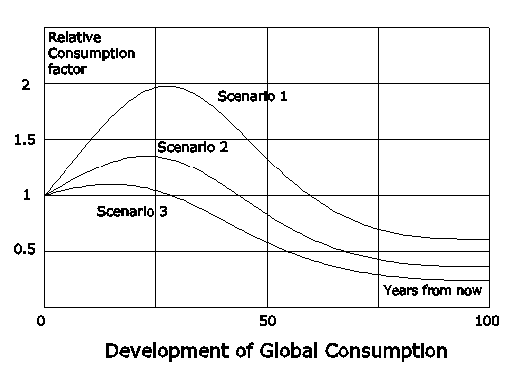
As can be seen from the graph, global consumption will increase by a factor of about 2 in the first scenario before again being reduced.
In the second consumption will grow by about a third and it will take about 40 years before the consumption again will be reduced to the present level.
In scenario 3 there will be only a moderate increase in global consumption to begin with - but this scenario implies a very strong limitation on the possibility for increasing the standard of living in the developing countries.
The reasons for the initial growth in global consumption of course are, that population growth in the developing countries can not be expected to stop immediately and the growth in per capita consumption in these countries - which necessarely must be assumed.
The conclusion is, that even with very strict policies on reducing global population the impact on the evironment resulting from consumption growth would have to be counteracted by increasing resource productivity (eco-efficiency).
Expressed with the Paul Ehrlich equation I = P * A * T: The global consumption P * A will grow for a considerable period even with the very strict assumptions made. Therefore T must be reduced if I is not to increase compared to today.